Welcome

Part of the beauty of being on sabbatical is that there are no time constraints and no set agenda. So...this blog will be a series of reflections, written as my heart is moved to share them. I will be in Kenya and Tanzania for six weeks beginning November 1st. Welcome to my adventure! To find out more about the Canadian charity that I am spending time with, please go to their website: www.sautimoja.org

Thursday, 10 November 2011

Another tribe - another view

A few days ago we went on another road trip - this time to Qachacha.  The road there wasn't too bad - meaning that we managed to drive it without getting stuck!  There was one place where we had to put down some big rocks in a mud hole so that the driver could get through - and thankfully it worked.  Qachacha is where many Borana people live.  In Kenya there are several different tribes - in Marsabit, people tend to live in small communities of their own people within the larger town.  In my last post I gave you a glimpse of the Rendille people who are pastoralists - moving their animals around to find food.  The Borana also have livestock, but they are agriculturalists - they tend to have farmland and cattle.  Their houses tend to be quite different than the Rendille houses.  Here is a sample:
Life has been extremely difficult for these farmers, especially with the severity of the drought.  Tim wrote an update on the conditions that will explain it more fully than I can:
"The highlands around Marsabit are very suitable for production of maize and beans, which provides another source of food for locals.  Normally, good rains would be a cause for optimism among those who have a field.  This season, it is different; most fields are overgrown with weeds.  As most cattle have died, farmers are without ox traction for plowing the fields.  Only a few could afford seed for planting, and have planted a small plot.  Others have been so discouraged by repeated crop failure associated with unreliable rains that they did not buy seed; it is much too early to say that they made a bad choice.  (I am still unclear as to whom and how many were provided a packet of maize seed by the Ministry of Agriculture.) Weed control will be a huge problem, as few have food or cash to pay casual labourers who would normally weed the fields.  The bottom line is that, in spite of good rains, local grain production will have minimal impact on hunger here."
One of the interesting things we saw was that some are now using camels to plow their fields.  Camels are strong enough and can plow large areas, but when a camel is tired, it will just lie down - and it is very hard to get it moving again!  However, here are a couple of pictures of the camels at work:
One of the reasons for going to Qachacha was to interview a couple of the widows who have received support from Sauti Moja.  We wanted to find out how they are doing - whether their goats survived the drought and how they are managing to look after themselves and their families at this time.  Phillip and Martha are on staff with Sauti Moja Marsabit, and they went with us as interpreters since these widows don't speak English at all.  Here is a picture of Tim and Phillip with one of the widows:
Martha and I interviewed two widows, Darmi and Fatuma.  Darmi invited us into her home, and while we talked, her daughter was doing the dishes.  She would fan the flames of the fire to keep the water hot, so the room was quite smoky.  Here are Darmi and her daughter:
Darmi's husband died some time ago.  Darmi was the second wife and had been living on another piece of land.  But after his death, she moved to the land where his first wife was living - he had left the land to look after both of his wives.  She was a bit nervous about how they would get along, but since they each have their own houses, it is working ok.  Having 5 children to feed means that Darmi is constantly working - she said you can't just sit on your hands when you have hungry children.  She was given 4 goats by Sauti Moja - one died in the drought, but she said now that the rains have come and there is pasture land nearby, the others should survive and begin to multiply.  She is clear that her goats would not have survived without the support of hay and extra feed that she received from Sauti Moja.  One of the main tasks she has is to go and get water.  It is a full day's work - she walks 3 hours to get to the well, then stands in a long line to wait for the water, then walks back, often not arriving back until late in the evening.  The donkey which she received from Sauti Moja carries most of the water, and she carries some herself.  She calls it a luxury when the rains come because then she doesn't have to do the long walk to get water.  When I asked her what gives her the strength to keep going, she was quick to say it is God - God pushes her from behind and gives her the strength to cope.  Darmi is an amazing woman - strong, and capable, and even though she and I did not speak the same language, we seemed to laugh often together.  I have no idea any longer what was so funny, but here we are...
When I was thanking Darmi for letting me come for a visit in her home, I told her that what I would remember about her was her strength.  I know that it is very good for me to be here, and for me to hear the stories from these women who lead such different lives than I do.  But the reality is that I will be returning home, and they will continue to walk this road - I am glad that I have this picture to remind me not to forget the road that Darmi will be walking...
Fatuma lived up the road a piece and in a different looking house.  Her husband died a little over a year ago, and her brother allowed her to put up her home on his piece of land.  She was able to buy some sheet metal for the roof because of a small loan she received from an institution that helps women in business.  But her home has lots of open spaces between the walls and the roof and must be quite cold in the rainy season.  She told us she is just grateful to have a place to sleep with her 4 children.  Here is a picture of Fatuma with Martha - I wanted to show you her home, but I also wanted you to see their faces - so two pictures:


Fatuma is a very wise woman.  She said some things that have stayed with me since our visit.  One was that it is very hard when you are hungry, and your children are hungry, for you to think about anyone who may be hungry in another house.  That is why she is so thankful for the donors who live in other countries who don't forget about those who are hungry in Kenya - they are very, very thankful that Sauti Moja doesn't forget about them.  The other thing that has stayed with me is her reflections about poverty.  She said that when she received the goats, the donkey and the feed from Sauti Moja, she began to feel like she might climb out of poverty.  The drought made it impossible to climb out - one of her goats did not survive.  However, one of her goats is now pregnant, and when it gives birth, Fatuma will have milk for her children again.  So even though the drought was a huge setback, she feels like she may climb out of the deep poverty because Sauti Moja is helping to keep her goats alive.  And finally, she offered her reflections about education.  She had to drop out of school at Primary 5 because her mother was ill and they needed Fatuma to help out at home.  Her parents didn't realize the importance of education, and so they never encouraged Fatuma to return to school.  Fatuma now realizes how important education is, and so she is going to do everything she can to make sure her children stay in school.   Again, I was deeply touched by the courage, and the faith of this woman.  She told me clearly that it was God who keeps her going - without God she would not be able to provide a life for her children.  I told her that I would be sharing her story with the churches that I work with back in Canada, and so she could know that there is now a whole community of faithful people across the ocean who would be praying for her well-being.  I will leave you with this picture of Fatuma in her home:

Posted by Picasa

Wednesday, 9 November 2011

A glimpse at the pastoral life of the Rendille people


The longer I am in this area, the more I realize how little I know - and how impossible it will be for me to really understand this life when I am only here for three weeks!  I am doing my best to keep my eyes and my ears open.  So even though I will share some of what I have heard here, please know that there is LOTS more to learn, and this is just a small glimpse at life as I saw it at Logologo.  In order to understand it a little more fully, you could go to www.sautimoja.org, and look at the sustainable livelihoods under the Kenya heading.  The Rendille people build their homes in family clusters and those homes are placed in a particular order according to your age in the family.  When we went to see the camels, we were at one of the Moga family sites.  To keep their animals close to them at night, they have pens, and the fences for those enclosures they have are made of an intertwining of brambles and branches.  I didn't get a very good picture of it, but these young camels are in such an enclosure to keep them separate while the milking happens.
During the dry season, the goats are taken long distances away in order to find some pasture for them to feed on.  They will travel several days away with them.  Once the rains come, they can bring their animals back to their home communities.  This year the rain came much earlier than expected.  One of the great difficulties is that during the drought when the animals are not getting enough food or water, those that don't die of starvation become very weak.  When the rains do come, the animals don't have enough body fat to keep them warm, so they will often die of hypothermia.  One of the farmers that Tim was telling us about lost all 135 of his animals that way - came out to see them and they were all lying in the field.  Very sad. And very difficult to recover from such a huge loss.  When Sauti Moja provides the widows with goats, they also provide them with hay and with the veterinary medicines needed to keep them healthy.  As one widow told us, without that extra support given by Sauti Moja, she would have lost all her animals.  The drought meant she lost 2 goats, but 2 survived - much thanks to Sauti Moja.
Now that the rains have come, and the pastures are greener closer to home, the goats, sheep and donkeys can be taken out early in the morning, but not to such great distances.  They can then come home again in the evening.  And then the worry will be wild animals, so the men will often stay outside beside those pens at night to make sure the animals stay safe.  That is another difficulty when a woman is alone - it is much more difficult to keep the animals safe.  One of the widows told us that she would take the goats into her house at night sometimes, both to keep them warm, and to keep them safe.  This is a picture showing a small grouping of Rendille homes.
Back in Canada, the focus is on snow and blizzards.  Here it is very much on rain and drought.  It is clear that people are very, very happy to have the rains right now.  Rather than dust everywhere, I am seeing a much different picture of Marsabit, with mud and puddles everywhere.  The beauty of the green bushes and grass is extremely welcome.  However, we had lunch today with Tim's friend Paul, who lives in HulaHula, a community about 6 km south of Marsabit on the same road we followed to Logologo.  As is common with nomads, walking is just a way of life - Paul walks back and forth between the communities every day.  Anyways, he told us that the road is even worse today than it was last weekend when we were on it.  Last night there was a huge storm with thunder, lightening, strong winds, and a very heavy downpour.  Even fewer trucks are getting through right now - he told us there are trucks thoroughly stuck right near his community.  So now one of the concerns is whether or not supplies such as food and petrol for vehicles will be able to get through.  But as another man said, "we are happy to be stuck as long as the rains keep coming!"  One of the things that I am learning as I spend time in this community is that it is important to appreciate the sun when it is out, and to give thanks for the rain when it arrives.  Both are needed.  But since you have no control over one or the other, all you can really do is simply live in the moment and know that this is the moment you have, so live it well!
Posted by Picasa

Tuesday, 8 November 2011

Logologo - real live camels!!

While we were at Logologo, we enjoyed the hospitality of a woman's organization.  After that long drive over such challenging roads, we were very ready for a more comfortable place to rest than the bench seat of our little truck.  This is the guest room that we stayed in.  I will show you the outside, and what the beds looked like on the inside.
The women looked after us very well.  We had their chai tea, which was boiled tea leaves with packaged milk and sugar added - very tasty.  Our supper was rice and cabbage and spinach, along with both chicken and lamb - we were hungry, and it definitely filled us up.  The next morning we traveled a short distance to where one family had about 6 homes, and all their livestock - goats and camels.  I wasn't feeling very well (although it turned out to just be a bit of upset stomach which I recovered from quickly), so we were driven there.  The people here walk everywhere - and not just around the block.  They will easily walk 40 km if they have to - it is the only way they have to get where they need to go.  Remember, these are pastoralist people - nomads.  They move great distances to make sure that their animals have water and pasture.  In the dry season they can cover immense distances.
We arrived at this grouping of homes just as they were about to milk the camels.  Generally the camels are milked between 6 and 7 in the morning - we arrived about 6:45 and they were just about to begin - in African time that meant we only waited about 15 or 20 minutes!  In Rendille culture, women are never allowed to milk the camels, but it was ok for me to stand close by.  Before milking, the men wash their hands very carefully.  When camels are distressed, their milk dries up.  So it is always two men that milk, one on either side of the camel, and they milk as quickly as they can.  Here, they are catching the milk in traditional woven baskets which are completely leak-proof.  More often now they don't have any of those baskets left and milk into plastic containers.  I was glad to see the baskets.  So...at long last...pictures of real live camels being milked!
Sunset United Church raised enough money to buy 4 camels.  None of these camels here were purchased by Sauti Moja.  The community where they have provided camels was another very long drive away and with the condition of the roads, it would have been much too difficult to travel to.  So, just know that camels are very much needed and will be deeply appreciated wherever and whenever they may arrive.  Selkirk United Church spent time learning some facts about camels before I came.  They will be happy to know that I wasn't spit on even once!  Here is another fact:  in the first picture you can see that they tied one of the front legs up? That is so the camel can't kick.  They have a very powerful kick - and they can kick sideways.  So just like with horses, you need to be very careful in how you approach them - they can really hurt a person if they want to.  As I continue to learn more about camels, and about how they are necessary to survival for the Rendille people, I will share what I learn with all of you.  And then it was back to our guest house to have tea and wait for our ride back to Marsabit - I think it was about a 3 or 4 hour wait - it's good to learn a new pattern of managing time!  I must be on sabbatical or something!


Monday, 7 November 2011

Making heart connections in Kamboi

Our first stop on the road towards Logologo was the village of Kamboi.  Karen and Lorne have been supporters of Sauti Moja for several years, and one of the child mothers they have supported is Ntamian.  Ntamian is quite shy, but it was clear that she was happy to meet her sponsors, and to introduce them to her daughter, Felista.  It was quite wonderful watching the conversation unfold, and hearing Ntamian's dreams of working her way through school to one day becoming a doctor.  No longer was Ntamian simply a picture on the computer.  Karen & Lorne were visibly moved to find themselves actually speaking with this girl, who they have heard about for years, who they have been supporting financially, and who is doing her best to provide a quality life for her child by making sure she gets an education.
This is the view from the front of Ntamian's home:

As we talked with Ntamian, others from her family and the village came to see what was going on.  This is Ntamian's sister - and her beautiful baby.
From there we went to visit with another child mother - Ahado - and her daughter Patricia.  As soon as we got near Ahado's home, we were surrounded by children in the village.  They were great fun - giggling at us and trying to teach us a song in Swahili.  As soon as we took their picture, they all wanted to see themselves - thank God for digital cameras!  As we laughed and played with the kids, we felt very welcomed by this tiny little village of Rendille people.
Right beside the tire we were sitting on with the children, one of the village women was sitting there and she was just too beautiful - I had to take her picture as well!  She was very gracious at posing for me - and she was just as giggly as the children when I showed the picture to her.

We met three child mothers from this community.  It was very good to be able to look them in the eye and commend them for working so hard to get their education.  We did the best we could to encourage them to dream big - and to believe in themselves so that their dreams could eventually become a reality.  In this part of Kenya, where simply to survive is a daily struggle, it truly is a miracle when children are able to make it all the way through secondary school.  But for these girls, who are mothers at such a young age, the struggle is doubly difficult.  I am so thankful for the work of Sauti Moja.  I watched as Tim and the others from their partner organization "PETI" talked with these young women.  They treated them with much respect and deep compassion.  I hope and I pray that people outside this country will continue to find ways to offer their support, both emotional and financial.  And I also encourage those of us who live back home in Canada to never ever take for granted the gift of education and the freedom to make choices about which education paths to follow.

Sunday, 6 November 2011

An adventure with Tim

Yesterday, at about 7:00 a.m., Tim began making the arrangements necessary for us to go and visit Logologo - a community about 50 km from Marsabit.  The first difficulty was that most of the usual vehicles that Sauti Moja hire for a trip like this were already being used.  With so much food aid being distributed in this area, every spare vehicle is put to use.  At about 10:00 he finally managed to find one - a Toyota 4 wheel drive truck.  The driver told us he would be ready to leave very soon.  In Africa that can mean many things apparently!  Our vehicle arrived about 1:30 I think.  We were definitely a full load - there were 3 in the cab of the truck, and four of us squeezed into the covered canopy - we did have a bench seat, but it was rather cozy fitting ourselves around the huge spare tire!  The other major problem was that it rained very heavy throughout the night and most of the morning.  This is what the Town of Marsabit looked like as we were leaving:
As we left town, it was clear that this was going to be a true adventure.  This road is part of the highway that goes from South Africa to Cairo - but oh my!  I still can't believe that we actually made it.  It is bad enough in the dry season, but with the rains, we had to cope with mud, which was both thick and very slick, and huge big pot-holes.  This is a glimpse of what we were driving through...
Our vehicle was relatively small.  But this road is travelled by many big trucks - often loaded down with food aid to be distributed in various communities along the way.  The only way the drivers are paid is if they deliver their cargo, so they wouldn't turn around.  The other vehicles along the road are buses, filled with passengers.  We passed one bus that had slid off the road, was at about a 45 degree angle in the deep mud, and they had been there all night.  As the sun comes out and dries up some of the mud, people are generally able to dig themselves out and carry on - when we returned this afternoon, the bus was no longer there, so I am glad that people didn't have to spend 2 nights out in the mud!  However, there were many other trucks stuck, often right up to their axles, and so in our little truck, our driver would change into 4 wheel drive (often not soon enough for the male passengers I was sitting with!), and we would find a way to get around these huge trucks, often by driving up on the bank, or through the ruts alongside where the trucks were stuck. Often there was a line of half a dozen of these big trucks or more, just parked and waiting for the roads to dry up enough to keep going.  Here is a picture of one of those trucks:
Apparently one of the ways of describing what it is like to ride over these roads is that the passengers are receiving an African massage.  What Karen told me is that we likely just saved ourselves some money on one of the newest weight-loss machines.  You can buy a machine that you stand on and it vibrates so fast you lose weight.  We figured we vibrated off a fair number of pounds on this trip!  Remember I said it was a 50 km trip?  It took us about 2 1/2 hours to drive it!  Here is a picture of our little truck:
Just so you know that it wasn't all about looking at mud and rocks and ruts, we did see some pretty spectacular scenery as we went up and around the mountain.  Here is one picture looking out over the flatlands:
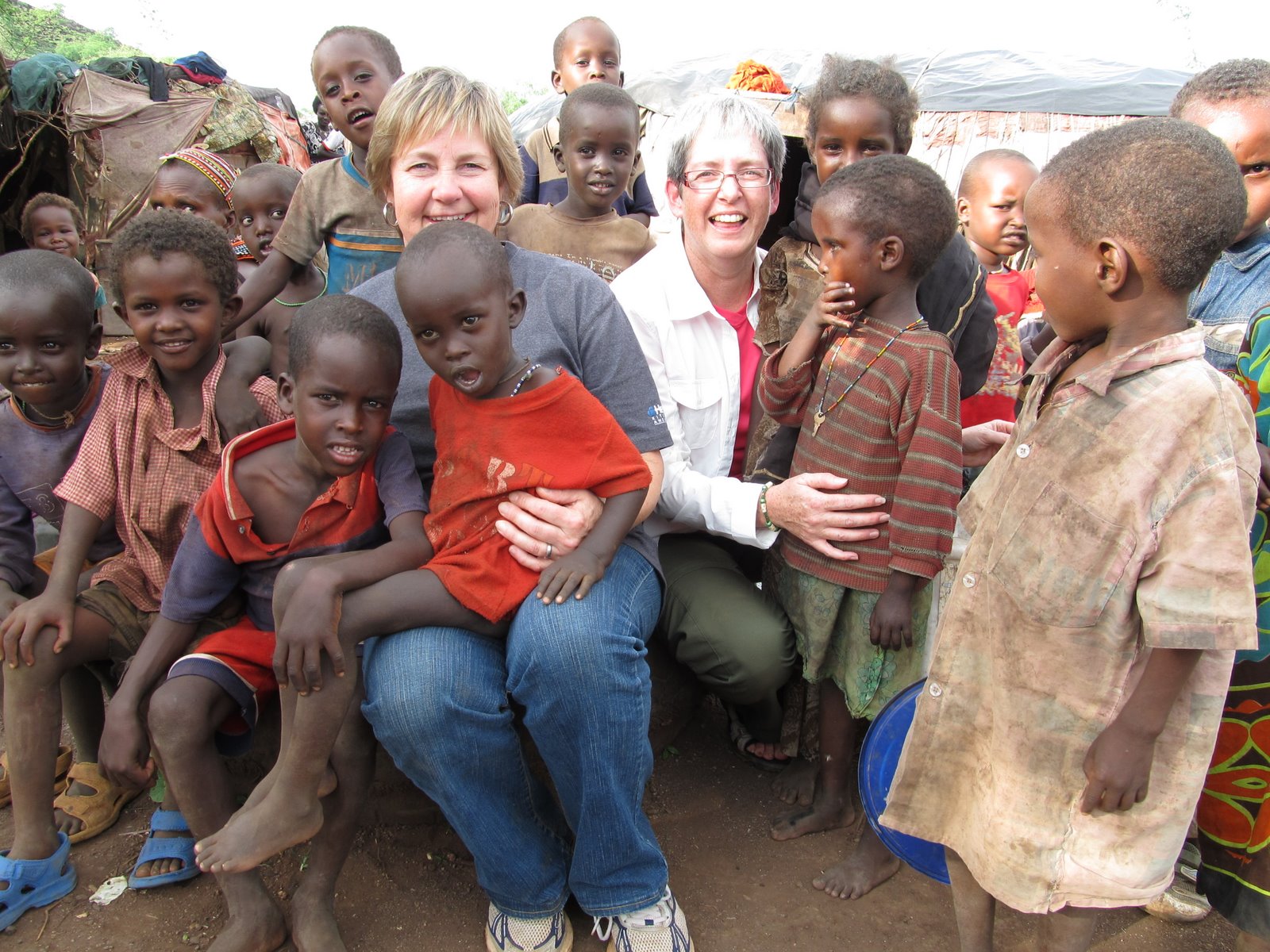
I will write more about the actual visit in my next post, but I will leave you with a picture that speaks volumes about why we did this trip.  Everywhere we went, the children were very excited to see us.  They laughed and giggled and were very much like children round the world.  They all wanted their pictures taken, and the beauty of a digital camera is that you can show them the picture immediately - which of course led to more belly laughs.  These little boys were quite thrilled to pose for me, and my guess is they would love to know that they are now part of this photo story of my trip to Kenya.  As you look into their faces may you find ways to give thanks for the gift of children worldwide.  And may we all find ways to work to build a world where children everywhere will be safe, and where their bellies will be full at night, and where they, each one of them,will  know themselves to be loved.

Posted by Picasa

Friday, 4 November 2011

My first glimpse of Marsabit

This morning began with a very long taxi ride to the airport in Nairobi.  The roads would have to be seen to be believed - makes me think I will never again complain about potholes in Regina - our cab could have disappeared in some of the holes we drove around today.  I am rather amazed at how the vehicles all seem to know how to drive without hitting the pedestrians, the bikes, the motorcycles, the occasional goat or cow, or other cars.  From where I was sitting, I had no idea what the rules of the road were!  But we did arrive safe and sound and began with all our bags getting weighed - mine was the heaviest, but was still under the limit thank goodness!  Each person then had to be weighed - made the check-in at Westjet seem very simple somehow!  This is the plane we then flew in - 8 people.  We flew high above the clouds, with the cabin air being pressurized just as it is in the larger planes.  So all we had to look at along the way was the tops of the clouds.  It was about a 2 hour flight.
This is Tim Wright, and his cousin Karen, and her husband Lorne.  Karen and Lorne are from Alberta and will be here with us until Tuesday.  One of the first things that Tim noticed was how very green it is right now.  The rains have come early, and there has been more rain in the last while than there has been in about two years.  Because the rains are heavy, and then the sun comes out right away, you can almost seen the grass growing - it gives everyone a sense of hope to see the green land rather than the usual clouds of dust.  However, the wet, muddy roads bring a new set of problems - many, many stuck vehicles.  The man who came to meet us at the airport told us that last week he had spent the night out in a mudhole in his vehicle waiting for someone to come and help get him out.  Any plans we make to go out and about will be contingent on whether it is raining, and whether we can find a 4 wheel drive vehicle available for use.  Many of the vehicles that would normally be available are being hired out for the food aid in the villages in the district around Marsabit.
While we are in Marsabit, we will be staying at the "Food for the Hungry" guest house in the town of Marsabit.  It is good to set myself up in this room and to know that I will be here for the next 3 weeks.

Today has been very full.  We have done a lot of walking around the townsite.  It is going to be difficult to take many pictures.  Partly because there will be some people who will expect to be paid if they think they are in any pictures.  And partly because it feels rather uncomfortable to look so much like a tourist.  We already stand out enough with the color of our skin - the last thing I want to do is feel like I am somehow putting this community on display.  I will do my best to get some pictures, but mostly I hope to be able to simply absorb being in this world for awhile, and find ways to share it with you as I continue to listen and to watch and to wonder.  I think what I am holding the closest in my heart tonight, is my thanks for the deep compassion of so many of the people we met today.  Compassion and generous hearts.  Life is far from easy for many people living here, but the sense of community is strong.  Tomorrow we are hoping to meet some of the child mothers who have been sponsored by Sauti Moja - I am looking forward to hearing their stories in the context of this place rather than simply reading about them on the website.  It is very good to be here.

Thursday, 3 November 2011

Yup - I'm in Africa!!

In spite of all my worrying about everything that could go wrong, I had a completely uneventual trip - yeah!!  It was a long two days of flying, but I managed to get all my connections, and sailed through customs with no difficulties.  It feels like it has been such a long build-up, that it is hard to believe that I am actually here!  I woke up to the sounds of many, many birds - and not chickadees or robins I might add.  For 2 nights I am staying at the Mennonite Guest House in Nairobi.  It is very comfortable, with this lovely little sitting area outside my room.

I have arrived here in the short rain season.  It is a bit cooler than normal - likely about 16 or 17 Celsius right now, but as the sun comes out and burns off some of the cloud, my guess is that it will warm up some.  There likely will be some rain most days, but that is more than manageable - it is a far cry from the cold winds at Gimli!  The colors of the vegetation here are amazingly vivid - these are some of the plants I see as I look out from that little patio towards the main room where we eat our breakfast...

Looking back from the place where we eat our breakfast, that is the building where my room is - I have one of the ground floor rooms.

My room is just behind those very colorful bushes..

I ate breakfast this morning with a man who is a volunteer with the Mennonite Central Committee - and he is from Ontario!  As we chatted, we discovered we have a friend from Canada in common - and what a small little world we live in!  He has been coming here for several years, so shortly he is going to take me for a walk to see some of the sites, and to find some lunch.  Tim Wright will be arriving this afternoon sometime, and tomorrow is the day that we will be heading up to Marsabit.  And so my adventure has begun...
ps.  For those of you who don't know, I think you can click on the picture itself and it will show up a little bigger on your screen - I will be uploading them pretty small so that it is quicker to upload.  Such a computer whiz that I am!
Posted by Picasa